Food Packaging Equipment Compliance Guide: FDA, EU 1935/2004 and Food-Contact Materials
- Share
- publisher
- TOP Y Machinery
- Issue Time
- Sep 23,2026
Summary
A practical guide to food packaging equipment compliance for buyers and food producers: which machine parts are food-contact, what the FDA and EU frameworks actually require, the six documents to request before shipment, how 304 and 316L differ in practice, why lubricant classification fails audits, and what changes when Machinery Regulation (EU) 2023/1230 replaces Directive 2006/42/EC on 20 January 2027.
Table of contents
- Which parts of a food packaging machine touch food
- The US position: food-contact substances under 21 CFR
- The EU position: 1935/2004, GMP 2023/2006 and migration limits
- What changes on 20 January 2027
- The six documents to request before shipment
- 304 or 316L: what a material spec does not cover
- Lubricants and cleaning chemicals: the line nobody audits
- Where compliance quietly breaks down
- US and EU requirements side by side
- FAQ
Why compliance is a material question, not a machine question
A food packaging machine is compliant when three separate things line up: the materials that come into contact with your product, the documents that prove what those materials are, and the geometry that lets you clean the machine between runs. Miss any one of the three and a machine can pass a factory trial with perfect bags and still fail your customer's audit three months later.
This is the point most buyers get wrong. Food packaging equipment compliance is rarely decided by the machine's performance. It is decided by what the machine is made of, by whether anyone can prove it, and by whether the surfaces can be cleaned to a verifiable endpoint. This guide sets out what the US and EU frameworks actually require, which parts of a machine fall inside those rules, and the document pack to ask for before you release a final payment.
Which parts of a food packaging machine touch food
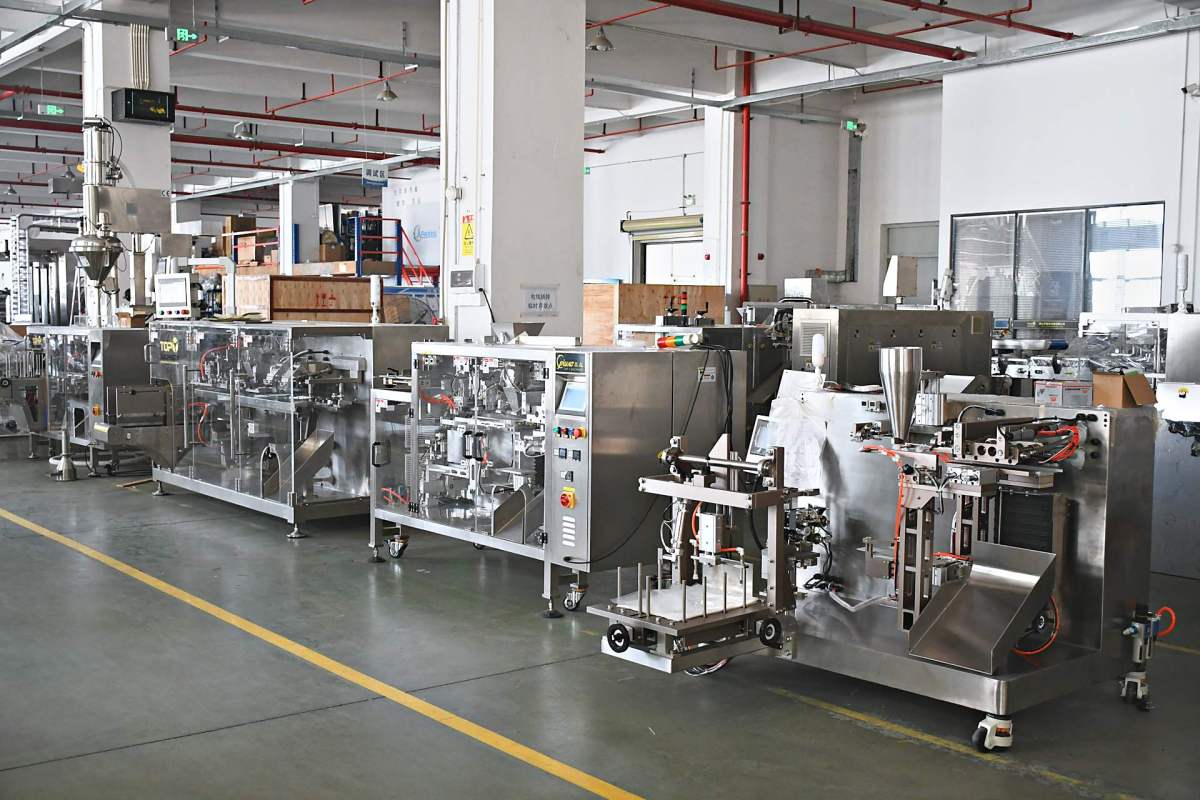
Regulators do not regulate "the machine". They regulate the substances and materials that contact food. So the practical first step is to split your machine into three zones and treat each one differently. Buyers who ask for "an FDA certificate for the machine" are asking for a document that does not exist; buyers who ask for a material declaration per contact part are asking for the document that does.
Zone 1 — direct food contact
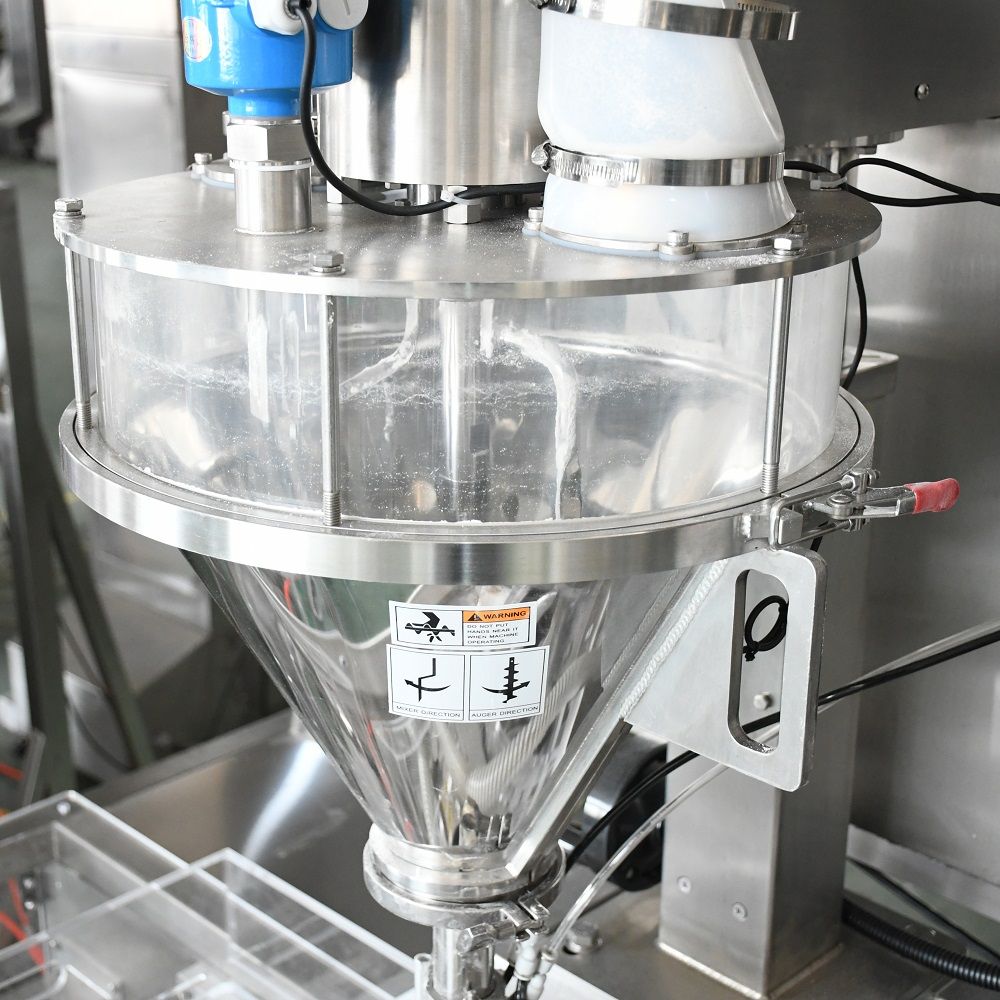
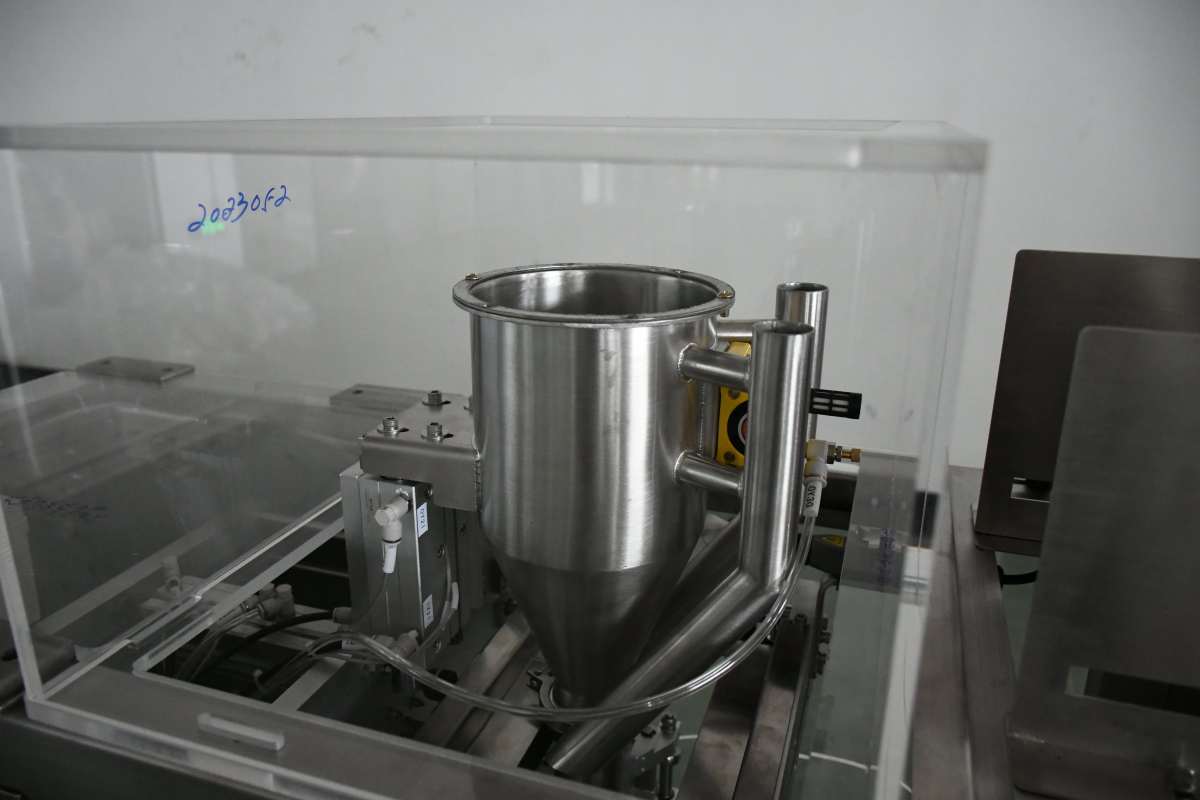
Hoppers and hopper lids, vibratory feed trays, multihead weigher buckets and chutes, auger screws, volumetric cups, filling nozzles, pump heads, product hoses, discharge chutes.
Zone 2 — splash and residue
Forming tube and collar, seal jaws, film path, cutter, product-side guards, trays under the fill zone. No intentional contact, but powder, oil, crumbs and condensate end up here.
Zone 3 — no contact
Frame, drive, electrical cabinet, pneumatic manifold, outer guarding. Cleaning and drainability still matter, because residue in these areas keeps the whole line out of a hygienic state.
The distinction matters because it decides which evidence you need. Zone 1 needs material declarations and, for plastics, a declaration of compliance. Zone 2 needs hygienic geometry and a cleanable design, even though no declaration is owed. Zone 3 needs neither, and specifying gold-plated requirements there only adds cost.
The US position: food-contact substances under 21 CFR
In the United States, the FDA regulates packaging machinery through the substances it is made of, not through a machine approval. Under the Federal Food, Drug, and Cosmetic Act, anything that contacts food must be a lawful food-contact substance. In practice the evidence takes one of four forms.
The single most useful thing to know: the FDA does not certify, register or approve packaging machines. It regulates food-contact substances. A supplier who offers you "an FDA certificate for the machine" is describing a document that does not exist, and the paper will not survive an audit.
- Listed in 21 CFR Parts 170–199. The indirect food additives regulations. Part 177 covers polymers; Part 178 covers adjuvants and adjuvants' production aids, including lubricants with incidental food contact. A supplier citing the specific section that covers their material is giving you a checkable statement.
- Food Contact Notification (FCN). Used for a substance not listed in 21 CFR for that end use, or for an expanded end use. An FCN belongs to the manufacturer who filed it, which is why you cannot inherit it from a different supplier.
- GRAS. Generally Recognized as Safe status, occasionally relevant for release agents and base oils.
- Threshold of regulation exemption. A lower-burden route for substances with negligible migration.
Two other rules shape machine design even though they are not material rules. Current Good Manufacturing Practice and preventive controls for human food, set out in 21 CFR Part 117, require that equipment be designed and maintained so food-contact surfaces are protected from contamination and so equipment is cleanable. And where a plant's hazard analysis identifies foreign material as a hazard, the line is expected to carry detection and rejection at a defined critical control point — which is a machinery requirement in everything but name.
For sanitary construction, US buyers commonly reference the 3-A Sanitary Standards. 3-A is applied to the product-contact side of food equipment and is a genuine design standard, but holding it is not the same as being FDA-approved, and the two are frequently confused in supplier literature.
The EU position: 1935/2004, GMP 2023/2006 and migration limits
The EU framework is more prescriptive about what has to be produced on paper, and it is where most Chinese-built packaging machines have their real documentation gap.
Regulation (EC) No 1935/2004
The framework regulation for materials and articles intended to come into contact with food. Its core test is that materials must not transfer constituents to food in quantities that could endanger health, cause an unacceptable change in composition, or deteriorate organoleptic properties. Article 16 puts the obligation to supply a Declaration of Compliance on the supplier.
Regulation (EC) No 2023/2006
Good manufacturing practice for food-contact materials. It requires a documented quality assurance system and traceability of materials back to their origin, so a failed seal or a contamination event can be traced to a material source.
Where a contact part is a plastic, the operative rule is Regulation (EU) No 10/2011 on plastic food-contact materials. It works through a positive list of authorised substances, a specific migration limit (SML) for individual substances, and an overall migration limit (OML) of 10 mg per dm² of food-contact surface. The evidence you receive is a Declaration of Compliance covering those points.
One practical consequence: a Declaration of Compliance is issued for a material or an article, not for a machine. If your machine has seven plastic or elastomeric contact parts, you are owed seven declarations or one consolidated document that lists them individually. A single page that names no parts is not a compliance document.
What changes on 20 January 2027
Machinery Regulation (EU) 2023/1230 replaces Directive 2006/42/EC on 20 January 2027, with no parallel transition period. Machines placed on the EU market up to and including 19 January 2027 must meet the Directive; from 20 January 2027 only the Regulation applies. Existing EC type-examination certificates remain valid to their stated expiry date, but any machine you order now with an EU destination should be quoted against the Regulation rather than the Directive.
The change is not only administrative. The Regulation adds essential health and safety requirements covering cybersecurity and remote access, expanded software safety requirements including updates and validation, and requirements for machine learning safety systems. Documentation may be supplied digitally for professional users. If you are specifying a packaging line in 2026 for delivery in 2027, this is the single most consequential compliance item on the table, and it is worth putting in writing which regime the builder is certifying against.
The six documents to request before shipment
Compliance is cheap to agree at the drawing stage and expensive to retrofit. This is the pack worth writing into the purchase order, with the reminder that each item should name the specific parts it covers rather than the machine as a whole.
Food-contact material declarations
For every Zone 1 part: alloy or polymer grade, supplier, the standard or regulation the statement relies on, and the date of issue. A declaration older than the last material substitution is not evidence.
Declaration of Compliance for EU destinations
Per Article 16 of 1935/2004 and, for plastics, Articles 15–16 of Regulation (EU) No 10/2011. It should list the contact parts individually and state the migration compliance basis.
Non-metallic parts list
Gaskets, O-rings, seals, PTFE tape, hoses, plastic guides and sight glasses — with material, temperature rating, food-contact status and chemical compatibility. This is the list that fails audits, because it is the list nobody compiles.
Lubricant schedule
Every lubrication point, the lubricant used, and its food-grade status. Points where incidental contact is possible should carry H1-registered or ISO 21469-certified product; points in a no-contact zone should be identified as such rather than left unstated.
Surface finish and weld standard
The roughness target for product-contact surfaces, how welds are treated and finished, and the hygienic design reference the builder is working to. Hygienic design guidance commonly calls for product-contact roughness around Ra ≤ 0.8 µm, continuous welds ground smooth, and no horizontal ledges that hold water.
As-built drawings and change control
Final drawings that match the machine shipped, plus the rule for how a material substitution after the order is raised, recorded and approved. Without this, every other document in the pack describes a machine you may not have received.
Ask for this list at the drawing review stage rather than at shipment. Agreeing a change of contact material while the machine is still lines on a drawing costs a conversation. Agreeing it after the hopper is welded costs a hopper.
304 or 316L: what a material spec does not cover
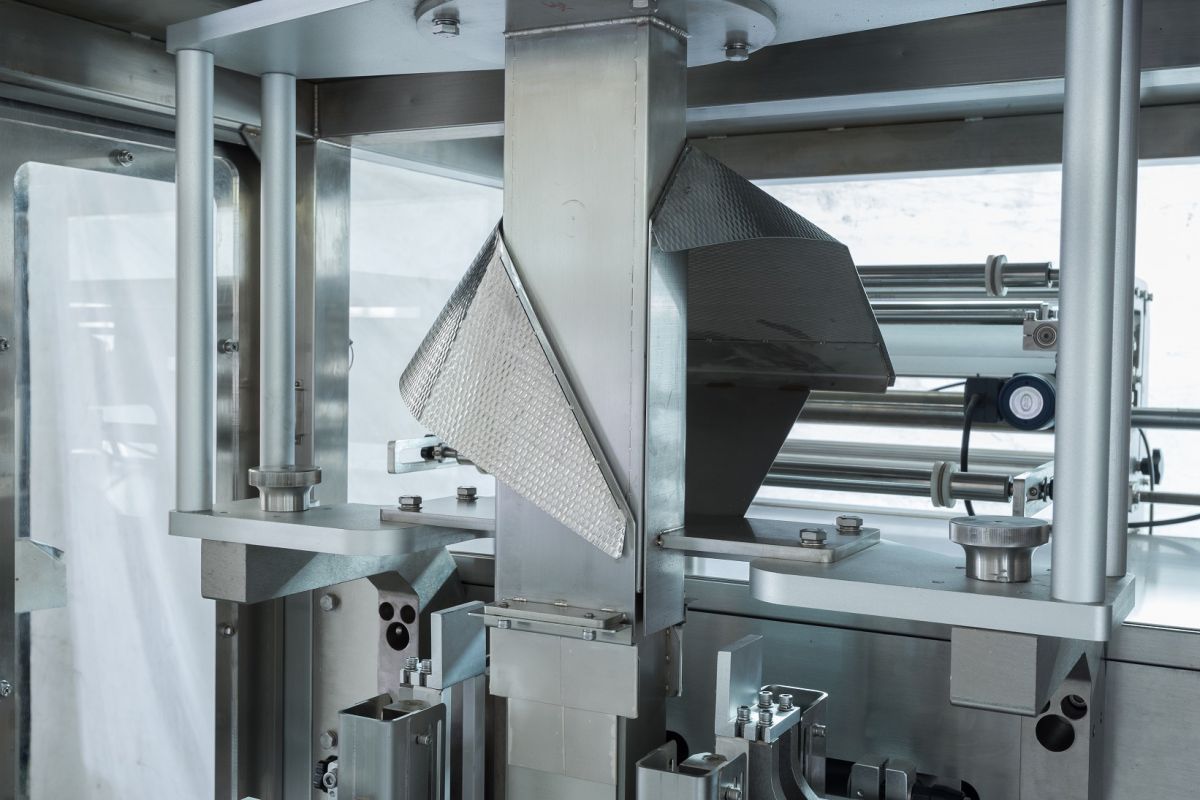
Most food packaging equipment sold out of China is built in SS 304, and for a large share of applications that is the correct choice. 316L is specified where chlorides, acids, salts or aggressive cleaning chemistry are present. Neither grade makes a machine compliant on its own, and specifying 316L across an entire machine is an expensive way to solve a problem that usually sits in three or four parts.
| Consideration | SS 304 | SS 316L |
|---|---|---|
| Typical fit | Dry and neutral products — snacks, nuts, grains, powders, tea | Salty, acidic or high-moisture products — sauces, dairy, meat, marine, liquid fill |
| Chloride resistance | Limited; pitting becomes a real risk with chlorides and elevated temperature | Molybdenum content improves pitting resistance in chloride service |
| Cleaning chemistry | Fine with neutral and alkaline regimes; high-chloride sanitizers need review | Better tolerance of chloride-containing sanitizers and washdown chemicals |
| Where it belongs | Default for frames, guarding, most contact parts in dry applications | Specify at nozzles, pump heads, hoses, hoppers and weighers handling aggressive product |
| Cost position | Baseline | Higher material cost; justify it by product chemistry, not by habit |
| Compliance value | None by itself — grade alone proves nothing | None by itself — a cleanable geometry matters more than the grade |
The last row is the one worth remembering. A 316L machine with a rough weld inside the hopper and a dead leg under the fill zone will fail a hygienic audit. A 304 machine with ground flush welds, sloped self-draining surfaces and radiused internal corners will pass it. Grade is a corrosion decision; finish and geometry are the compliance decisions.
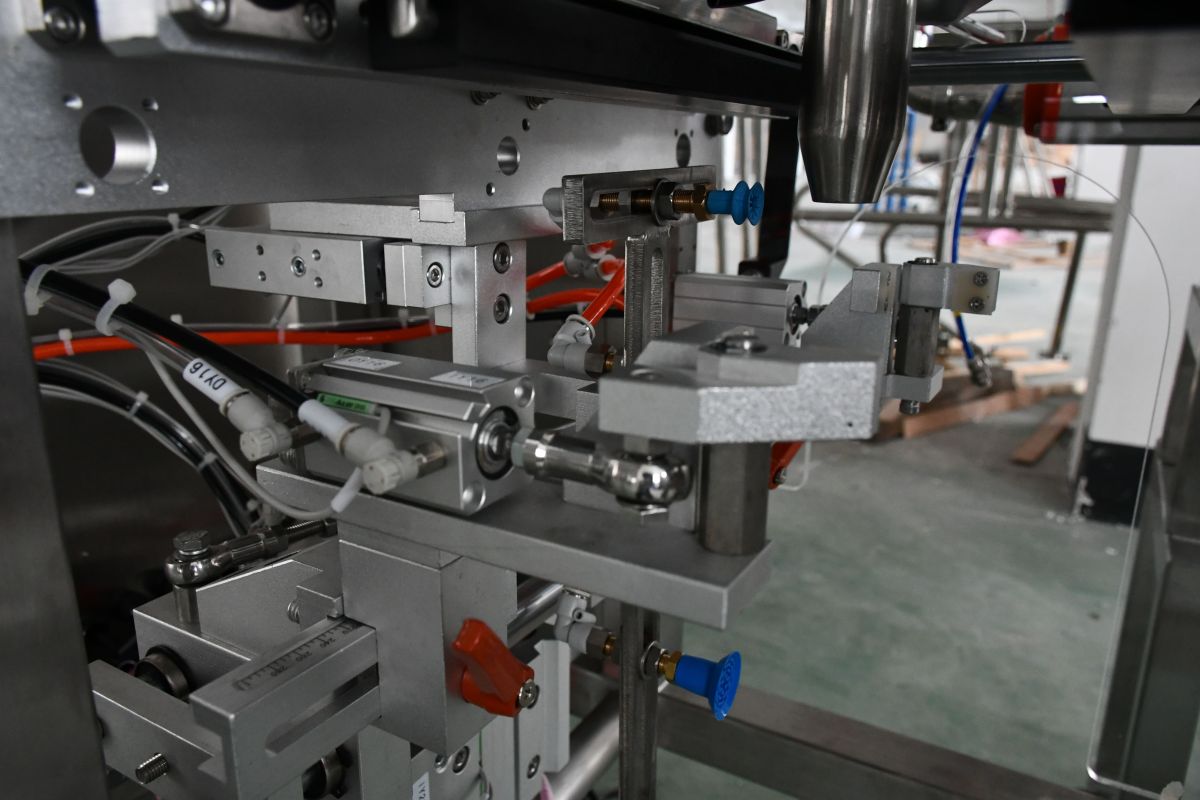
Lubricants and cleaning chemicals: the line nobody audits
Lubricant is the most common gap we see in buyer documentation, because it is invisible until it is a problem. In the US the reference is 21 CFR 178.3570, which governs lubricants with incidental food contact and caps incidental contact at 10 parts per million. Registration under the NSF H1 scheme, or certification to ISO 21469, is the third-party evidence that a product meets it. Note that the USDA programme that older datasheets still cite was discontinued in 1998.
| Classification | Where it may be used | What it proves |
|---|---|---|
| H1 | Points where incidental food contact is possible and technically unavoidable | Formulated to 21 CFR 178.3570; incidental contact limited to 10 ppm |
| H2 | Points where no contact with food is possible | Not a food-grade claim; must not drift into an H1 zone |
| H3 | Rust prevention on hooks, trolleys and similar equipment | Equipment must be cleaned before returning to service |
| 3H | Release agents on surfaces that contact food directly | A different and more permissive category — not interchangeable with H1 |
The failure mode is practical rather than regulatory. A plant consolidates on H2 because it is cheaper, a maintenance technician uses it at a bearing above the fill zone, and nobody notices until a complaint. Two habits prevent it: mark every lubrication point on the machine with its permitted classification, and keep the lubricant schedule in the same folder as the material declarations. Cleaning chemicals deserve the same treatment — a sanitizer that is aggressive to 304 in a chloride environment will surface as pitting on a contact surface long before it surfaces as a food safety event.
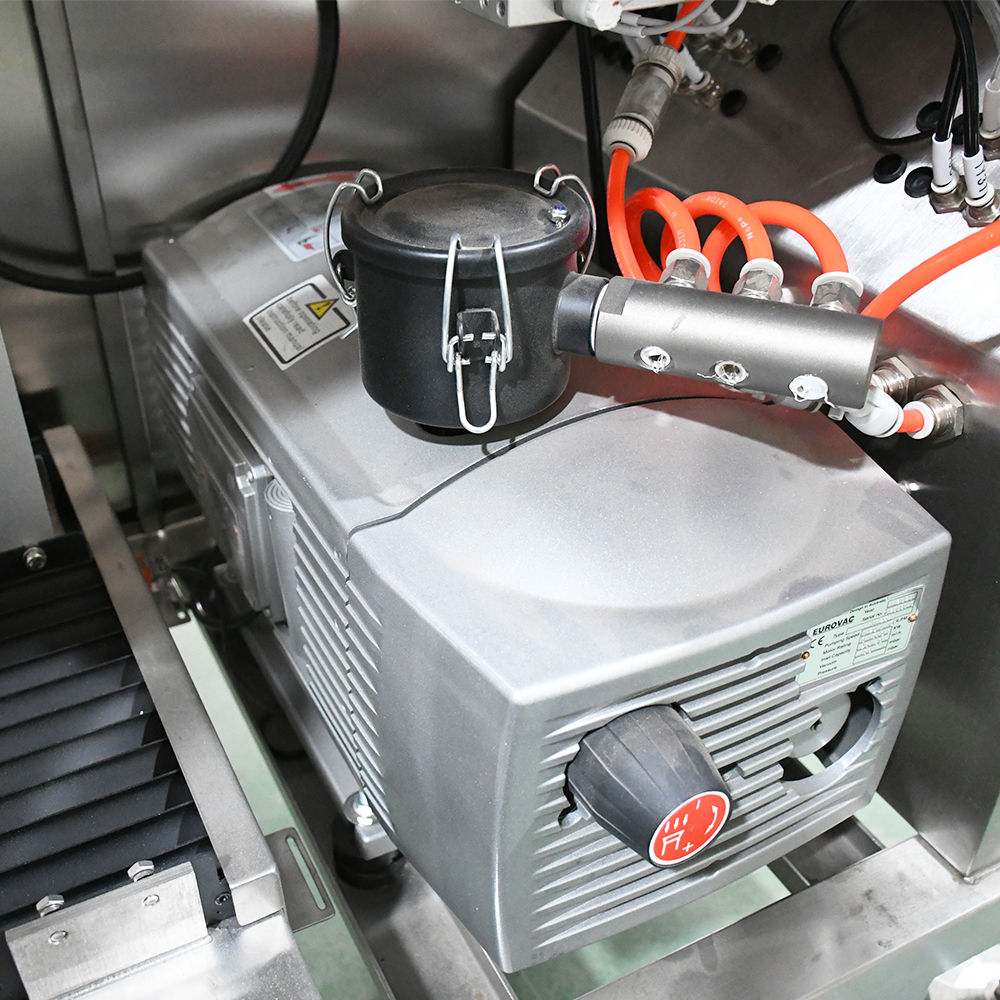
Where compliance quietly breaks down
Almost none of the failures above happen because someone ignored a regulation. They happen because a decision was made somewhere between the order and the shop floor and nobody wrote it down. That is a build-process problem, and it is the part of compliance that a specification sheet cannot fix.
How TOP Y Machinery closes the gap on the floor
From our manufacturing base in Foshan, Guangdong — established in October 2011, 4,500+ m² of workshop and a team of over 50 including electrical, mechanical design, commissioning and after-sales engineers — we build to a process designed to keep the compliance file and the machine in agreement.
- Drawings confirmed before production starts. Dimensions and production operations are marked on the drawing, and the drawings are issued for your review and confirmation first. Material and surface requirements agreed at that point become a document, so a later substitution is a recorded change rather than a workshop decision. It is also why drawing confirmation, not the purchase order, is the gate that starts the production clock.
- Batch assembly, then whole-unit commissioning. Sub-assemblies are built and proven in batches before integration, so a fault surfaces in the batch that caused it rather than at final testing.
- Real-material test runs. Machines are commissioned on the whole unit and run with actual product and actual film, not with empty cycles.
- Seal integrity tested, not assumed. Peel test, dye penetration test and burst test — the machine-level evidence that sits behind any claim about seal quality.
- Training records your quality system can file. Operators are signed off against practical checks at defined levels before handover, with records and control panel documentation the team keeps. When an auditor asks an operator how they set seal parameters and why, a written training record is the difference between a finding and a non-conformance.
None of this is exotic. It is the ordinary discipline of building to a confirmed drawing, testing against real product, and documenting what was done. It matters in a compliance article because it is exactly what a document pack is worth: if the machine was built to the drawing, the declarations describe the machine you own.
US and EU requirements side by side
| Requirement | United States | European Union |
|---|---|---|
| Governing framework | Food-contact substances under 21 CFR Parts 170–199 | Regulation (EC) No 1935/2004 |
| Core legal test | The substance in contact with food must be lawful for that use | No transfer of constituents that endangers health, changes composition or harms organoleptic quality |
| Evidence you receive | Material declaration referencing 21 CFR, an FCN, GRAS status or a TOR exemption | Declaration of Compliance per Article 16; for plastics, Regulation (EU) No 10/2011 |
| Quantitative limit | 10 ppm incidental contact benchmark for lubricants (21 CFR 178.3570) | OML of 10 mg/dm² for plastics, plus specific migration limits per substance |
| Machinery safety | Referenced to US industry standards and 3-A for sanitary construction | Directive 2006/42/EC until 19 Jan 2027, then Regulation (EU) 2023/1230 |
| Typical documentation gap | Declarations that name no specific parts | Declarations older than the last material change, or missing non-metallic parts |
Most destinations outside the two markets accept a Declaration of Compliance as the starting point, but always check the destination market's own requirements rather than assuming the EU pack travels. Whichever market you are selling into, the same three documents do the most work: a material declaration per contact part, a non-metallic parts list, and a lubricant schedule.
FAQ
Does the FDA certify food packaging machines?
No. The FDA regulates food-contact substances, not machines. There is no machine certificate, registration or approval. A supplier statement about "FDA approval" of a machine should be read as a statement about the materials used, and you should ask for the specific 21 CFR reference, FCN or GRAS basis behind it.
Do I need a Declaration of Compliance for the machine itself?
A Declaration of Compliance covers materials and articles that contact food, not a machine as a whole. For an EU destination you need material-level evidence per contact part, and for plastic or elastomeric contact parts a declaration referencing Regulation (EU) No 10/2011.
Is 316L required for food packaging equipment?
No. SS 304 is adequate for most dry and neutral products and is the standard in the majority of food packaging machines. Specify 316L at the specific parts handling salty, acidic or high-moisture products, or where chloride-containing cleaning chemicals are used. Grade is a corrosion decision, not a compliance one.
What changes for machines ordered now for 2027 delivery?
Machinery Regulation (EU) 2023/1230 applies from 20 January 2027 and replaces Directive 2006/42/EC with no parallel period. It adds requirements for cybersecurity and remote access, expanded software safety, and machine learning safety systems. Put in writing which regime the builder is certifying against.
Who is responsible for compliance, the buyer or the builder?
It is split by scope. The builder is responsible for the materials supplied, the design of the contact surfaces and the accuracy of the declarations. The buyer is responsible for the hazard analysis, for specifying the requirements in the purchase order, and for keeping the documentation current when product or cleaning chemistry changes.
Can we use standard industrial lubricant at a sealed lubrication point?
Only if that point is genuinely in a no-contact zone and stays there. The failure mode is drift: an H2 product used at a bearing above a fill zone where incidental contact is possible. Mark every lubrication point with its permitted classification and keep the schedule with the material declarations.
What to do before you place a deposit
Four things, in this order. Classify the machine's parts into the three zones so you know which parts actually owe you a document. Send the six-document list with the enquiry, not after the order. Agree materials, surface finish and lubricant classification at the drawing confirmation stage, where changes are still free. And for any EU destination, fix in writing whether the machine is being certified to Directive 2006/42/EC or Regulation (EU) 2023/1230.
Compliance is not a certificate you collect at the end. It is a set of decisions that get made whether or not you are in the room. Being in the room is the whole exercise.
Related reading
- The Comprehensive Guide to Industrial Food Packaging Equipment
- Food Packaging Machine Types in 2026: VFFS, HFFS, Rotary and Pouch Systems
- Packaging Machine Maintenance: Daily, Weekly and Monthly Checklist
- China Food Packaging Machine Manufacturers: How to Find a Reliable Supplier
- Manufacturing Capability: How Food Packaging Machines Are Built
- Operator Training for Food Packaging Machines