How Fully Automated Grains VFFS Packing Machines Work
- Share
- Issue Time
- Jun 18,2026
Summary
Fully automated Grains VFFS (Vertical Form, Fill, Seal) packing machines are essential for the efficient, precise, and hygienic packaging of granular products like rice, seeds, and lentils. These sophisticated systems integrate bag formation, product filling, and sealing into a continuous vertical motion, significantly streamlining the journey from farm to table. The core VFFS technology processes a flat film roll, shaping it into a tube, sealing the bottom, accurately filling it with the produc
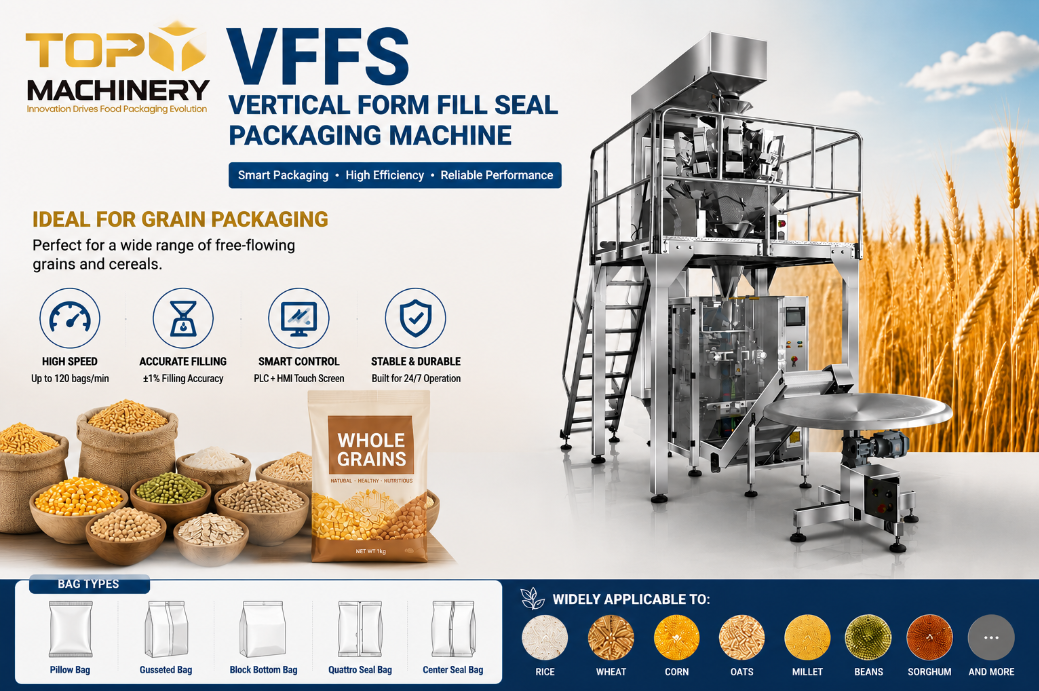
Hello there! Today, I want to take you on a journey into the incredibly efficient world of packaging. Specifically, we're going to dive deep into understanding how a fully automated Grains VFFS packing machine works. These machines are the unsung heroes in the journey of grains from the farm to our tables, ensuring that products like rice, seeds, lentils, and coffee beans are packaged with precision, speed, and hygiene.
At TOP Y Machinery, we believe in shedding light on the innovations that power modern processing. This blog will guide you through the fascinating mechanisms and undeniable advantages of these essential machines, showing you exactly what makes them a game-changer for grain packaging. We will explore the core technology, break down the process step-by-step, and highlight the key benefits that can transform a production line.
Unpacking the Basics: What Exactly is a Fully Automated Grains VFFS Packing Machine?
Before we delve into the intricate mechanics, let's establish a foundational understanding. A fully automated Grains VFFS packing machine is a sophisticated piece of equipment designed to package granular products with minimal human intervention. It combines the functions of creating a bag, filling it with a precise amount of product, and sealing it in a continuous vertical motion. This technology is fundamental to the modern food industry, offering unmatched speed and consistency. The "fully automated" aspect is crucial; it means the machine manages everything from feeding the packaging material to weighing the product and discharging the final, ready-for-sale bag.
Defining VFFS: The Vertical Form Fill Seal Technology
VFFS stands for Vertical Form, Fill, and Seal, which perfectly describes the sequence of operations. This technology is a cornerstone of the packaging industry, prized for its efficiency and versatility. The process starts with a large roll of flat packaging film, which is then vertically transported and shaped into a tube. This tube is sealed at the bottom, creating a pouch. The grain product is then dropped into this pouch, which is subsequently sealed at the top and cut to form an individual bag. This all happens in a continuous, high-speed vertical flow, hence the name. The beauty of VFFS lies in its ability to perform these three distinct steps—forming, filling, and sealing—in one seamless and fluid motion.
Key Components Making a Grains VFFS Packing Machine Fully Automated
A fully automated system is a symphony of precisely engineered components working in perfect harmony. While designs may vary, most Grains VFFS packing machines share a common set of core parts that enable their autonomous operation.
| Component | Function |
|---|---|
| Film Unwind System | Holds the large roll of packaging film and uses rollers and tension controls to feed it smoothly into the machine. |
| Forming Tube & Collar | Shapes the flat film into a vertical tube. The design of the collar is critical for creating the correct bag shape and size. |
| Dosing System (Weigher) | This is the heart of precision. For grains, this is typically a multi-head weigher or a linear weigher that measures the exact target weight of the product before dispensing. |
| Vertical Sealing Jaws | These heated jaws press against the overlapping edges of the film tube to create the vertical seal, forming the back of the bag. |
| Horizontal Sealing Jaws | These jaws perform two functions: they create the top seal of the filled bag and the bottom seal of the next bag simultaneously before a knife cuts them apart. |
| Control System (PLC & HMI) | The brain of the operation. The Programmable Logic Controller (PLC) executes the machine's functions based on pre-set parameters, while the Human-Machine Interface (HMI), often a touchscreen, allows operators to set recipes, monitor performance, and diagnose issues. |
| Sensors and Encoders | A network of sensors, such as photo-eye sensors for print registration and encoders for tracking film movement, ensures every step is executed with precision. |
Why Automation is a Must-Have for Grains Packaging Today
In today's competitive market, manual or semi-automatic packaging processes are no longer sufficient for businesses looking to scale. The move towards full automation in grain packaging is driven by several undeniable factors. Firstly, automation dramatically increases throughput; a machine can pack at a rate far exceeding any manual capability, often running 24/7 with consistent output. Secondly, it delivers unparalleled accuracy. Automated weighing systems minimize product giveaway, ensuring each bag meets its stated weight and reducing waste, which translates directly to cost savings. Finally, automation enhances food safety and hygiene by minimizing human contact with the product, a critical factor in the food industry. This leads to a longer shelf life, better product quality, and greater consumer confidence.
The Packaging Journey: Step-by-Step Operation of a Grains VFFS Packing Machine
Witnessing a Grains VFFS packing machine in action is like watching a perfectly choreographed dance. The entire process, from a flat roll of film to a finished bag of grains, happens in a matter of seconds. Let's break down this journey into its core steps to appreciate the engineering behind this efficiency. It's a vertical cascade of operations where each stage seamlessly transitions to the next, orchestrated by the machine's central control system.
From Roll to Bag: How Film Unwinding Forms the Perfect Pouch
The journey begins at the back of the machine with the film unwind system. A large roll of flat packaging film, often made of materials like polyethylene or laminates, is mounted on a spindle. Driven by belts, the film is pulled off the roll and guided through a series of rollers, known as the film transport assembly. This assembly maintains the correct tension and ensures the film tracks perfectly straight.
The film then travels up and over a specially shaped collar, known as the forming tube. As the film is pulled downward over this collar, it naturally folds around the tube, with the two outer edges of the film overlapping. At this point, a heated vertical sealer bar presses these edges together, creating the longitudinal or "back" seal and transforming the flat film into a continuous vertical tube of packaging material. This tube is the foundational structure for all the bags that will be formed.
Precision Filling: Ensuring Accurate Weighing of Your Grains Products
While the film tube is being formed, the dosing system is simultaneously at work. Positioned directly above the forming tube, a precision weigher calculates the exact amount of grain for each bag. For products like rice, beans, or seeds, a Granule VFFS Packing Machine is typically equipped with a multi-head weigher. This device uses a series of small weighing buckets to find the perfect combination that achieves the target weight with incredible accuracy, often within a fraction of a gram.
Once the machine's horizontal jaws have created the bottom seal of the bag-to-be, the control system signals the weigher to release its charge. The precisely weighed grains drop through the forming tube and into the waiting pouch. This synchronized timing is critical to maintaining a high-speed, continuous operation.
Sealing the Deal: Cutting and Finishing Each Bag of Grains
With the grains now inside the pouch, the final step is to seal and separate the bag. The horizontal sealing jaws come together to perform this crucial task. These powerful jaws have several functions:
- Top Seal: They press together and heat the film above the product level to create the top seal of the filled bag.
- Bottom Seal: At the exact same time, they create the bottom seal for the next bag that is being formed above it.
- Cutting: A knife, typically integrated within the jaw assembly, moves forward to cut the film between the two seals, releasing the completed bag.
The finished bag then drops onto a conveyor or into a collection bin, ready for casing and shipping. Meanwhile, the film tube is pulled down by one bag length, and the entire cycle repeats itself—fill, seal, cut—with a rhythm that can produce anywhere from 30 to over 100 bags per minute, depending on the product and bag size.
Advanced Controls and Sensors: The Brains Behind Our TOP Y Machinery Grains VFFS Packing Machine
This entire high-speed process is governed by a sophisticated control system. The PLC (Programmable Logic Controller) is the "brain," executing commands with split-second timing. The HMI (Human Machine Interface) touchscreen is the "face," allowing operators to easily set parameters like bag length, target weight, and sealing temperature.
A network of sensors provides constant feedback to the PLC. A photo-eye, or registration sensor, reads print marks on the film to ensure that any branding or nutritional information is a perfectly centered on each bag. Encoders measure the exact length of film being pulled for each cycle, guaranteeing consistent bag sizes. These intelligent controls not only ensure flawless operation but also allow for quick changeovers between different products or bag sizes, making our TOP Y Machinery Grains VFFS packing machines incredibly flexible and powerful.
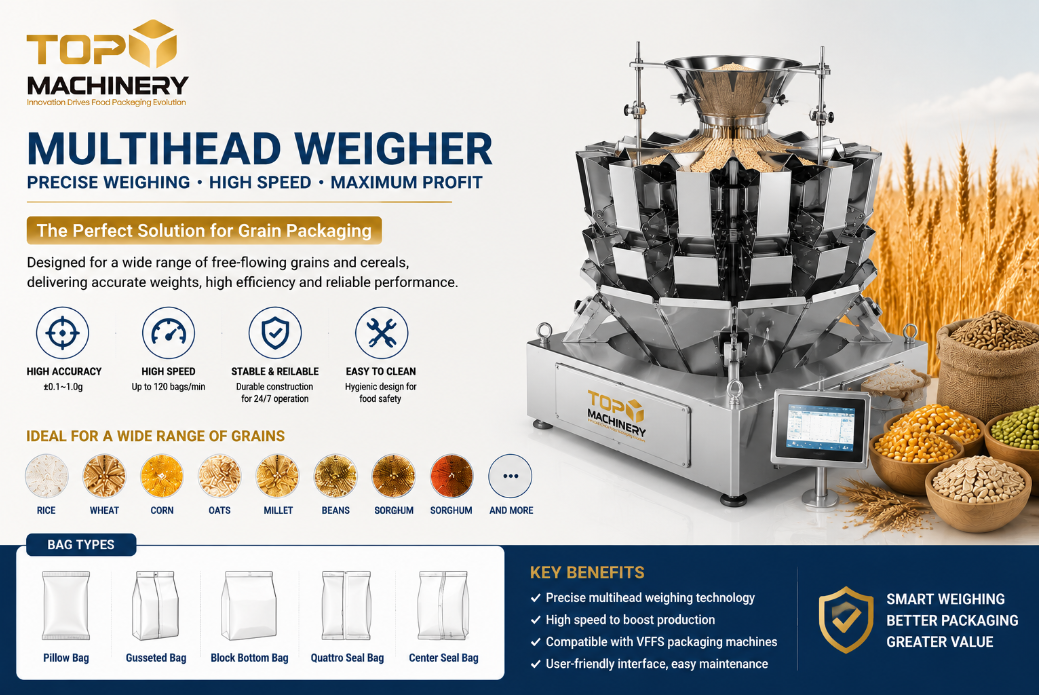
Innovations in Action: Key Technologies Shaping Modern Grains VFFS Packing Machines
The world of packaging machinery is not static. Continuous innovation is pushing the boundaries of what's possible, making Grains VFFS packing machines faster, smarter, and more efficient than ever before. These advancements aren't just about incremental improvements; they represent transformative technologies that address the core challenges of packaging diverse grain products, from delicate seeds to robust coffee beans. Let's explore some of the key technologies that are shaping the modern landscape.
Multi-Head Weighers: Achieving Unmatched Accuracy for Diverse Grains
One of the most significant innovations for packaging granular products is the integration of the multi-head weigher. This technology has revolutionized product weighing. Imagine a circular arrangement of 10, 14, or even 24 individual weigh buckets. The product is fed into the center of the weigher and distributed to these buckets. A computer then rapidly calculates the combination of buckets that gets closest to the target weight without being under. This process, known as combinational weighing, allows for astonishing accuracy, drastically reducing product giveaway compared to other dosing methods. For high-value grains or seeds, this level of precision provides a rapid return on investment.
Intelligent Film Handling: Customization for Various Grain Textures and Sizes
Not all packaging films are created equal, and not all grains behave the same way. Modern Grains VFFS packing machines incorporate intelligent film handling systems to manage this complexity. This includes automatic film tracking and alignment, where sensors monitor the film's position and make micro-adjustments to the unwind system to prevent it from drifting. This ensures a consistent, high-quality appearance for every bag. Furthermore, advanced features like automatic film splicing can be added, allowing the machine to automatically join the end of an expiring film roll to the start of a new one without stopping production, maximizing uptime and efficiency.
User-Friendly Interfaces and Remote Monitoring for Your Grains VFFS Packing Machine
The "brains" of the machine have also seen a major evolution. Gone are the days of complex, cryptic controls. Today's machines feature intuitive, full-color touchscreen HMIs (Human-Machine Interfaces). These interfaces use graphical icons and simple menus to allow operators to:
- Store and recall "recipes" for different products and bag sizes with a single touch.
- Monitor key performance indicators (KPIs) like production speed, efficiency, and downtime in real-time.
- Access on-screen diagnostics and troubleshooting guides to quickly resolve issues.
Furthermore, with the rise of Industry 4.0, many machines now offer remote monitoring capabilities. This allows managers and maintenance staff to view the machine's status, performance, and alarms from a laptop or smartphone, enabling proactive maintenance and better production planning.
Seamless Integration: Connecting Your Packing Machine to Upstream and Downstream Equipment
A packing machine does not operate in a vacuum. It is a critical part of a larger production line. Modern VFFS systems are designed for seamless integration with both upstream and downstream equipment.
- Upstream: They can be linked to bucket elevators or auger conveyors that automatically feed grain into the weigher, ensuring a continuous product supply.
- Downstream: The machine's output can be synchronized with checkweighers to verify bag weight, metal detectors for quality control, and automatic case packers that load the finished bags into cardboard boxes.
This level of integration creates a fully automated "end-of-line" packaging solution that minimizes manual labor, improves workflow, and maximizes overall plant efficiency. To explore the full range of possibilities and find a solution that fits your line, feel free to Contact us for a detailed consultation.
The Benefits Unleashed: Why Invest in a Fully Automated Grains VFFS Packing Machine?
The decision to invest in new manufacturing equipment is significant, but the returns offered by a fully automated Grains VFFS packing machine are compelling and multifaceted. This technology acts as a catalyst, unlocking new levels of productivity, profitability, and quality. The benefits extend far beyond simply putting a product in a bag; they impact your entire operation, from the bottom line to workplace safety. Let's unpack the transformative advantages that make this investment a strategic imperative for any serious grain producer.
Skyrocketing Efficiency: Boosting Production Speed with Your Grains VFFS Packing Machine
The most immediate and noticeable benefit is the dramatic increase in production speed. A fully automated VFFS machine can operate continuously at speeds that are impossible to achieve with manual or semi-automatic methods, often packaging between 30 to over 100 bags per minute. This consistent, high-speed output means you can meet demand spikes, reduce lead times, and significantly increase your overall production capacity without needing to expand your facility's physical footprint. The machine works tirelessly, 24/7 if needed, ensuring your production targets are met with predictable and reliable performance.
Reducing Waste and Costs: The Financial Advantages of Automated Grains Packaging
Automation is a powerful tool for cost reduction. The precision of automated weighers, such as multi-head systems, minimizes "product giveaway"—the small extra amount often added in manual processes to avoid underweight packages. Over millions of bags, saving even a few grams of product per bag translates into substantial financial savings. Furthermore, automated film handling reduces packaging material waste, and the overall efficiency leads to lower energy consumption per unit packaged. Reduced labor costs, less product waste, and optimized material usage all contribute to a lower total cost of ownership and a healthier bottom line.
Enhancing Hygiene and Shelf Life for Your Grain Products
In the food industry, hygiene is non-negotiable. Fully automated systems are designed with this in mind. They are typically constructed from stainless steel and other food-grade materials, with easy-to-clean surfaces. The automated process drastically reduces human contact with the grain, minimizing the risk of contamination and ensuring a more hygienic final product. Additionally, many VFFS machines can be equipped with a gas flushing system. This process, also known as Modified Atmosphere Packaging (MAP), replaces the oxygen inside the bag with an inert gas like nitrogen just before sealing. This inhibits the growth of aerobic microorganisms and slows down oxidation, significantly extending the shelf life of the grains, preserving their freshness, and protecting their flavor and nutritional value.
Improving Workplace Safety and Labor Optimization with TOP Y Machinery Solutions
Automating repetitive and physically demanding tasks like scooping, weighing, and sealing has a profound impact on workplace safety. It reduces the risk of repetitive strain injuries (RSIs) and other ergonomic issues associated with manual packing. By taking over these monotonous tasks, the machine frees up your valuable human workforce to focus on more complex, value-added roles such as quality control, machine supervision, and maintenance. This not only creates a safer work environment but also leads to better labor optimization and can improve employee morale and job satisfaction. At TOP Y Machinery, our solutions are designed to empower your workforce, not just replace manual labor.
Making the Right Choice: Selecting the Ideal Grains VFFS Packing Machine for Your Needs
Choosing the right packaging machine is a critical decision that will impact your production efficiency and profitability for years to come. With a wide array of options available, it's essential to approach the selection process systematically. The ideal Grains VFFS packing machine is not a one-size-fits-all solution; it's the one that perfectly aligns with your specific products, production goals, and operational environment. Here are key factors to consider to ensure you make an informed and strategic investment.
Assessing Your Capacity and Grain Type Requirements
The first step is to thoroughly analyze your product and production needs.
- Grain Characteristics: What kind of grains will you be packaging? Are they free-flowing like rice, fragile like certain seeds, or dusty like flour-coated products? The nature of the product will determine the best type of weigher (e.g., multi-head, linear, auger) and handling system.
- Production Speed: What is your target output in bags per minute or per day? Be realistic about your current needs but also consider future growth. Choose a machine with a capacity that can comfortably meet your forecasts.
- Bag Types and Sizes: What bag styles (e.g., pillow bag, gusseted bag) and sizes will you be running? Ensure the machine you select is versatile enough to handle your required range of bag dimensions and styles.
Considering Machine Footprint and Production Line Integration
Think about where the machine will physically go and how it will connect with your existing setup.
- Footprint: Every square foot of your production floor is valuable. Measure your available space and compare it to the machine's dimensions. Pay special attention to the height, as VFFS machines, especially those with multi-head weighers, can be quite tall.
- Line Integration: How will the VFFS machine receive the product, and what happens to the bags after they are discharged? Consider the necessary upstream equipment (like bucket elevators or feed hoppers) and downstream equipment (like takeout conveyors, checkweighers, or case packers). A well-designed machine should have flexible I/O ports and control logic for easy integration.
The Importance of After-Sales Support and Spare Parts Availability
A packaging machine is a long-term investment, and its performance depends on more than just its initial quality. The support you receive after the purchase is just as important.
- Technical Support: Does the supplier offer comprehensive technical support, including installation, operator training, and troubleshooting? Is support available in your time zone and language?
- Spare Parts: How quickly can you get critical spare parts? A machine that is down for days waiting for a part can cripple production. Choose a supplier, like TOP Y Machinery, that maintains a robust inventory of common wear parts and can ship them quickly.
- Documentation: Ensure the machine comes with thorough documentation, including operator manuals, electrical schematics, and parts lists. A detailed Catalog Download can often provide a good preliminary overview of a supplier's offerings and professionalism.
Understanding the Long-Term ROI from Your TOP Y Machinery Grains VFFS Packing Machine
Finally, look beyond the initial purchase price and evaluate the machine's long-term Return on Investment (ROI). A cheaper machine might have a lower initial cost but could end up being more expensive over its lifetime due to lower efficiency, higher waste, and frequent downtime.
Calculate your potential ROI by considering:
- Increased throughput and subsequent revenue.
- Savings from reduced product giveaway due to higher weighing accuracy.
- Labor savings from automation.
- Savings from reduced material waste.
- Gains from improved product quality and longer shelf life.
A high-quality Granule VFFS Packing Machine from a reputable supplier like TOP Y Machinery is an asset that pays for itself through enhanced efficiency, unwavering reliability, and superior product quality.
Key Takeaways
To help you digest the comprehensive information we've covered, here are the crucial points about how fully automated Grains VFFS packing machines work and why they are a transformative investment for any grain business.
- Core Function: VFFS stands for Vertical Form, Fill, Seal. These machines automate the entire packaging process by forming a bag from a roll of film, filling it with a precise amount of grain, and sealing it in a continuous vertical motion.
- The Automated Process is a Symphony of Components: The seamless operation is made possible by key components working in perfect harmony. This includes the Film Unwind System for feeding material, the Forming Tube for shaping the bag, a precision Dosing System (like a multi-head weigher) for accuracy, and Sealing Jaws to finish the package. The entire process is orchestrated by an advanced PLC Control System.
- Automation Drives Profitability: The primary reasons to automate are financial and operational. Automation leads to a massive increase in production speed, significantly reduces costly product giveaway through precise weighing, minimizes packaging material waste, and lowers labor costs. These factors combine to deliver a strong and rapid Return on Investment (ROI).
- Quality and Safety are Paramount: Automation significantly enhances food safety by minimizing human contact with the product, reducing the risk of contamination. Technologies like Modified Atmosphere Packaging (MAP) or gas flushing can be integrated to extend the shelf life of the grain, preserving its freshness and quality. This also contributes to a safer working environment by eliminating repetitive manual tasks.
- Modern Innovations are Game-Changers: Today's Grains VFFS machines are smarter and more efficient than ever. Key innovations include Multi-Head Weighers for unparalleled weighing accuracy, Intelligent Film Handling for managing various materials without stopping, user-friendly Touchscreen Interfaces (HMIs) for easy operation, and Remote Monitoring capabilities for data-driven production management.
- Integration is Key to Efficiency: A VFFS machine is part of a larger system. Modern designs emphasize seamless integration with upstream equipment (like feeders and elevators) and downstream equipment (like checkweighers and case packers) to create a fully automated, end-to-end packaging line that maximizes throughput and minimizes bottlenecks.
- Making the Right Choice is Crucial: Selecting the correct machine requires a careful assessment of your specific needs. You must consider your grain type, required speed, bag sizes, and available factory footprint. Equally important is evaluating the supplier's after-sales support, spare parts availability, and their ability to provide a solution with the best long-term ROI, not just the lowest initial price.
Embracing this technology is a strategic move that positions a business for growth, efficiency, and a competitive edge in the modern marketplace.
Frequently Asked Questions (FAQs)
Here are answers to some of the most common questions we receive about Grains VFFS packing machines.
What types of grain products can be packaged with a VFFS machine?
A Granule VFFS Packing Machine is exceptionally versatile. It is ideal for a wide range of free-flowing and semi-free-flowing granular products. This includes staple foods like rice, lentils, beans, and sugar, as well as specialty items like quinoa, seeds (chia, sunflower, pumpkin), coffee beans (whole or ground), granola, oats, and even popcorn kernels. The key is to match the product's characteristics with the right dosing system; for instance, a multi-head weigher is perfect for most grains, while an auger filler might be better for fine, powdery products that are mixed with grains.
How fast can a Grains VFFS Packing Machine operate?
The speed, measured in bags per minute (BPM), can vary significantly based on several factors. A typical range for a Grains VFFS machine is from 20 to 120 BPM. The main factors influencing speed are:
- Product: Lighter, more voluminous products take longer to settle in the bag.
- Bag Size: Larger bags require more film to be pulled and more product to be weighed and dropped, which naturally slows down the cycle time.
- Film Type: Some materials require longer sealing times or more careful handling.
- Weigher Speed: The speed of the multi-head weigher or other dosing system is often the limiting factor. A reputable manufacturer can provide an accurate speed estimate after analyzing your specific product and bag requirements.
What is Modified Atmosphere Packaging (MAP) and do I need it for my grains?
Modified Atmosphere Packaging (MAP) is a technology where the air inside a package is replaced with a carefully controlled mixture of gases (usually nitrogen for dry goods) just before the final seal is made. For grains, the primary goal of MAP is to remove oxygen. Oxygen promotes the growth of aerobic microbes and leads to oxidative rancidity, which can make a product stale. By flushing the bag with nitrogen, you significantly extend the product's shelf life, preserve its freshness, flavor, and color, and protect it from pests. While not every grain product requires it, MAP is highly recommended for high-value organic products, nuts, seeds, and coffee to ensure the highest quality product reaches the consumer.
How difficult is it to change from one bag size or product to another?
Modern VFFS machines are designed for flexibility and quick changeovers. On a machine with a user-friendly HMI, an operator can often switch between pre-programmed "recipes" with a few taps on a screen. This automatically adjusts parameters like bag length and weigher settings. The physical changeover involves a few steps:
- Changing the Film Roll: This is a quick process, especially on machines designed for easy access.
- Changing the Forming Tube: This is the main component that needs to be swapped to change the bag width. Many modern machines use tool-less designs that allow for a forming tube to be changed in just 5-15 minutes. Overall, a complete changeover on a modern machine can typically be accomplished in under 30 minutes by a trained operator, minimizing downtime between production runs.
What kind of maintenance do these machines require?
Like any industrial equipment, Grains VFFS machines require regular maintenance to ensure longevity and optimal performance. This can be broken down into three categories:
- Daily: Basic cleaning at the end of a shift to remove product dust and debris. Operators should also perform a visual inspection of belts, seals, and sensors.
- Weekly: More thorough cleaning, inspection of wear parts like sealing jaw inserts and cutting knives, and checking belt tension.
- Preventive Maintenance (Monthly/Quarterly): This involves following the manufacturer's recommended schedule for lubricating parts, replacing common wear items before they fail, and checking electrical connections. A good preventive maintenance program is the single best way to avoid unexpected downtime. For detailed schedules and parts lists, you can always Contact us.
In conclusion, we've explored the intricate yet highly effective operations of fully automated Grains VFFS packing machines. From the precise dance of the film unwind to the final, secure seal, these technological marvels are truly at the heart of modern, efficient grain packaging. They stand as a testament to how smart automation can revolutionize a production line.
By adopting such advanced solutions, businesses can significantly improve their operational efficiency, reduce costs, enhance product quality, and secure a competitive edge in the market. Investing in this technology is not just an equipment upgrade; it's a strategic move towards a more profitable and sustainable future.
I hope this detailed guide has helped you understand the profound impact and sophisticated workings of these machines. At TOP Y Machinery, we are committed to providing innovative and reliable packaging solutions that meet the evolving needs of the grain industry. If you have any more questions or wish to explore how these machines can benefit your specific operation, please do not hesitate to Contact us. Our team of experts is ready to assist you. Also, feel free to browse our Catalog Download for more information on our complete range of packaging solutions.